Yesterday a client asked me if I could give her an exercise to improve her posture. I gave her a short, confused answer about why that’s hard to do, but felt afterwards that I missed so much. So here’s the long answer, Lucia 🙂
What is “bad posture”?
Well, for starters, what is “bad posture”? I’m using quotes because there’s no ideal posture that suits everyone. The body simply does what it has to do to get through its daily tasks as best it can. Given a certain load, like sitting at a desk all day, it’ll use what it has available in terms of muscle strength, endurance and balance to keep everything working while saving a bit of energy for later.

So the body will generally look for a position where it can rest during the day. Quite often that involves slumping or letting the head fall forward. Sitting as tall and straight as possible takes muscular effort for most of us.
Telling yourself to “sit up straight” will probably make you sit straighter. But if you have to brace yourself to stay there, it can get tiring pretty quickly. I’m more interested in finding a position that feels supported without having to work so hard to hold it. The best posture is the one that comes without adding extra force or tension and the one that gives you support. Gravity has a lot to do with this, and how your body lines up affects how much muscle force you need to stay where you are. Ida Rolf put gravity at the centre of her work. More on that in a bit.
By the way, during my studies as a massage therapist, there was not much talk about posture. Today postural training seems to be gaining popularity in Sweden, but the science behind treating pain by changing someone’s posture is still limited. I’d call my thinking “science-informed” (I hope) instead of ”clinically proven”. Some of this comes from my Anatomy Trains Structural Integration training and what I’ve read, some from what I’ve seen in the treatment room, and some is my own take on how the bits fit together.
Manual therapy is hard to study because there are so many moving parts. How are clients assessed? How are treatments performed? Which underlying model is the therapist using? And what are we measuring afterwards? Someone might turn their head further after a session, feel less pain a week later, or stand upright without back pain. Those are three different results, and how you measure each one matters. Then there’s the question of how much of any change is still there a few months later.
Does how you sit change how easily you can turn?
- Sit up straight in your chair, then let your upper chest slump and your head fall forward.
- With your head in that position, gently look over one shoulder, like you would when driving a car. How far can you turn, and how easy is it?
- Now sit up straighter. Take a breath and imagine a string running through your spine and pulling you up.
- Try looking over the same shoulder again. Is it any easier?
If it is, we could say that sitting a bit straighter made that particular movement easier for you. That sounds reasonable to me, coming from an engineering background. Change the starting position and the same movement can feel different. So if someone comes in with neck pain and has trouble looking over their shoulder, playing around with the position of their upper back sounds reasonable as well.
On the other hand, someone else can sit in exactly the same way and be very content with life, and not have any pain. They can turn their head as far as they need to and their neck feels fine. So that person probably doesn’t need any postural work, I guess.
How adaptable is your posture?
I believe the way your bony bits line up affects how you can move. What I’m interested in is whether you can move in the ways you need to and handle a bit extra when life asks for it.
Adaptable is a key word for me. Most of us go through different challenges in life. That could be extra work, stress at home or at work, or some new movement we’d like to try. Can your body handle the extra load, and can it settle back down afterwards? If it can, you’re probably fine. But if you can handle your usual daily load and a little extra leaves you sore or stiff for days, you might be close to a line that limits what you feel like doing, and in a larger sense, might limit your life in the future.
Back to posture and gravity
If your body were a straight stick standing on end, gravity would pull straight down through it. Gravity would be nice force that stabilizes. Now picture someone whose hips sit forward, whose back goes backwards a bit to balance that out, and whose head comes forward again on top. Their centre of mass might still be over the same spot as the straight stick-person, but the effort of keeping everything in balance is larger. That effort could be freed up for you to use in a better.
A little bit like a game of Jenga. When the bricks are stacked neatly, you can see how each one gets support from the one below. Shift a few bricks and the tower can still stand, but the load goes through it differently. Luckily, your body is quite a bit smarter than a Jenga tower. It has muscles, a smart nervous system, it can shift its weight, and it does this all day long.
Both positions can be balanced. What can change is where you feel the effort of staying there, and how much effort it takes.
Does that sound reasonable to me? Yep!
How much of a difference it makes to a particular person, and whether that difference lasts, are the bits I’m curious about. There’s research on Structural Integration that looks at things like movement and pain, and those are the kinds of results I’d like to get into a bit more.
Where does a posture start?
Is a forward head position just a neck position gone wrong? I think the body is supersmart. It does what it has to do to manage its daily tasks. So maybe your head is forward because your chest has sunk a little and your rib cage sits further back. But why is the rib cage back? Maybe because of where the pelvis sits. And why does the pelvis sit there? Well, what are the legs and feet doing?
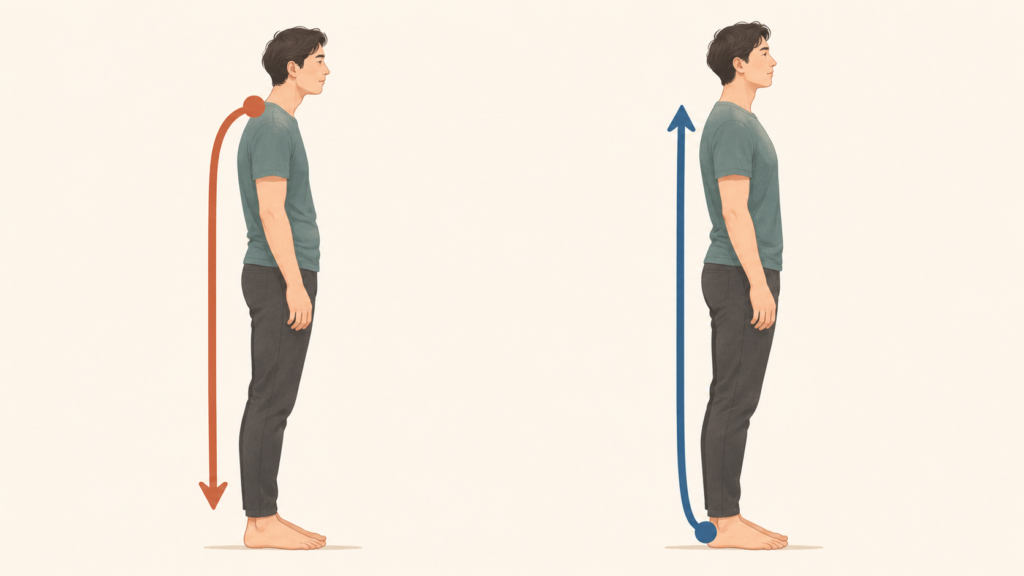
That’s one possible chain of events. It could go the other way, too. A neck you’ve been holding stiffly for whatever reason might change the way you turn through your rib cage or shift your weight on your feet. I usually start looking at the feet because the floor gives me a good reference point when you’re standing. Starting at the feet tells me where I began looking. Where the pattern began is a separate question. The map is not the territory!
How did we end up standing like this in the first place?
Well, children are great at copying what other people do. I sometimes wonder how much of the way we stand and walk comes from watching the people around us when we’re learning. You can see a child, a parent and a grandparent walking at the same pace with their feet turned out in much the same way. There could be a genetic component to that. Some of the shapes of our bones and joints are inherited, which can make certain positions easier. But since I’ve seen people change the way they stand and move after treatments, I’m curious about how much comes from the environment, too.
Growing up is one thing. The speed of growing up might be another. If you were the tallest in your class for a while, maybe you tried to make yourself a little shorter to fit in. The shortest person might have been trying to squeeze out every inch. And how we feel can show up in how we carry ourselves. You might make yourself a bit smaller when you feel shy, or take up a bit more space when you feel confident. Think about how you stand when you’re happy to see someone compared with how you stand after a really sh*tty day.
Injuries are also in play. An old knee injury might make you put more weight on the other leg. The pelvis might tilt, the lower back might adjust, and the rib cage might rotate a little so you can face the world straight on. Then the head makes its own adjustment on top of that. So much of what I see in a body reading could be a compensation for a compensation for a compensation.
And let’s add age on top of that! Over the years, how much we move and train can change, and we can lose some strength along the way. That might change which positions feel easy to spend time in.
When I’m working with a client, it’s useful to know about old injuries or operations because those are areas we might want to check a bit more carefully. Working with the body can also bring up emotions, and I’m fine with that. My role there is to give you a bit of time and let you decide if you’d like to pause or carry on.
So how is “bad posture” fixed?
Going to the gym will probably make you stronger and better able to handle the load on your back and neck during a workday. I’d happily recommend that, or any other exercise you enjoy. We’re made to move! Yoga or Pilates can also help you explore different positions and become more aware of what your body is doing. And awareness is one of the things I think helps when you’re trying to change a habit you’ve had for 20 or 30 years.
There are a lot of videos on YouTube about different postural issues. Conor Harris has a lot of good material. The tricky bit is knowing where to start and how to progress. If you’ve given yourself a programme of 20 minutes a day for six months, I can see why you might give up somewhere along the way. One small exercise might be the start of a whole postural journey, though, so I’m all for that. I’d have an easier time choosing one for you if you told me what you’d like to be able to do more easily.
How do I work with posture?
As a massage therapist, I’ll often look at someone’s posture when they come in for a massage. A lot of the people I meet carry their head a bit forward. If they have a sore upper back and neck, I’ll usually work on helping those areas relax. If there’s time and it seems useful, I might also work on the front of the neck and around the chest and upper ribs, to work with a slightly larger view.
With Structural Integration, I’ve bought into the idea of looking at how the whole body lines up and how the different parts work together. I use the fascial lines that Tom Myers describes in Anatomy Trains to do a body reading from the feet up. Ida Rolf’s work came first, and Myers later developed his map of the fascial lines. It’s a model I find useful because it gives me some structure for what to look at, where to work and what to come back to in the next session. So it basically answers the question: with this client – where do I start and what do I do next.
For instance, say a foot doesn’t pronate much as you put weight on it. I might do some work underneath the foot and around the lower leg, then ask you to stand and walk a little.
Maybe the tissues move a bit differently, maybe you’re sensing the foot more clearly or using the muscles differently, or maybe there’s a bit of all of that going on. Either way, I’m interested in what happens when you take a few steps. Does the foot feel any different? Is it easier to roll through the step?
If it feels different – why does it feel different?
Did we “open the fascia”, said in my best new-age voice? 🙂
Or was it the underlying muscles that responded or was it the nervous system in control of it all that got an upgrade? Or all of this? Not sure, but the result is important, regardless of why it occurred.
A bit more about Structural Integration and ATSI
Ida Rolf developed Structural Integration in the 20th century. Rolfing is one form of it, and the version I work with is called Anatomy Trains Structural Integration, or ATSI. A session starts by looking at how you stand and move, and talking about what you notice in your day-to-day life.
During the hands-on work, I might ask you to get up and walk, turn, shift your weight or move the joint we’re working around. And by “we”, I mean you and me. I think of Structural Integration as a conversation between two bodies. I get to see what happens, and you get to feel it for yourself.
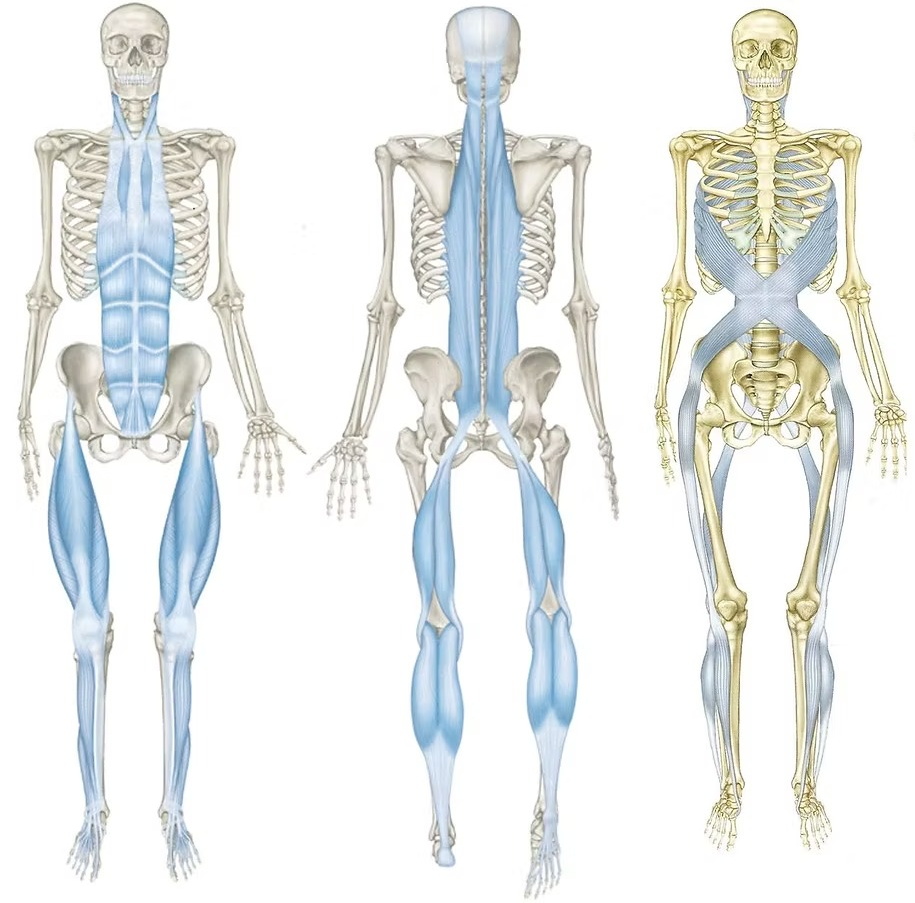
In the ATSI three-series, we have three sessions to look at the body as a whole. We typically spend one session on the lower body, one on the upper body and one bringing the two together. Or it could be one session on the front, one on the back and one on sides.
If you’ve come in because something feels awkward when you dance or do yoga, for example, we can come back to that movement as we go. I like that because you already know what the movement usually feels like and you can tell me if there’s a difference.
The ATSI 12-session series (coming in February 2027) gives us more time to work through the body in stages. The first sessions focus more on the outer layers and how you take support. Later on we spend more time with deeper areas, and towards the end we look at how it all comes together as you move. There’s also more time to find out what you notice between sessions, when you’re back at your desk or out for a walk or doing whatever you normally do.
Does this fix “bad posture”? It might. Or it might change what you mean by “better posture” in the first place. What I’m after is a bit more adaptability, easier movement and a better sense of where you are in space. I believe that if a position feels easier and more comfortable, there’s a good chance you’ll find it again without having to remind yourself all day. We fix cars but help people, you could say.
What if I just want a body reading?
Would you like to get a postural assessment, aka a body reading, and then work on it on your own? Sure. Book a slot and we can do a detailed body reading, look at the movements you’d like to make easier and talk about where you could start. Afterwards you can decide how you want to go on.
So, Lucia, could I give you an exercise? Yes 🙂 I’d start over by asking what you’d like to be able to do more easily. Then we could try one small thing and see if it makes a difference.